New York deli
New York pastrami in Israel: what makes it so special?
New York-style pastrami is not a kind of cold cut. It is a whole method — a salt cure, a spice crust, a long smoke, and then a steaming stage that is precisely what turns a tough cut into something that gives way. Here is what actually happens, and why it tastes nothing like what you know.
What is New York-style pastrami?
New York-style pastrami is a whole beef cut taken through four stages: a salt cure, a coating of spice built around black pepper and coriander, a long smoke, and finally steaming. Only after all of that does it get sliced — hot, by hand, and thick.
What separates it from other smoked meat is not just time. Each stage does something specific: the salt draws out moisture and tightens the muscle fibres, the spice builds a crust, the smoke supplies flavour and colour, and the steam — the part nobody talks about — is what breaks down connective tissue and turns a hard-working cut tender.
In New York the classic cut is actually navel, a fatty section from the belly, rather than brisket. In practice brisket is what most of the world uses today: far easier to source, and it stands up well to the cure, the smoke and a long steam. The result is leaner and more fibrous, and it slices clean.
New York Jewish deli culture
The deli — delicatessen — reached New York through the German delicatessen shops of the mid-1800s. The Jewish version differed from them mostly by being kosher. As immigration from Romania and Eastern Europe grew, those shops became an institution.
A point many accounts miss: the deli peaked not during the immigration wave itself but in the 1920s and 1930s, when the American-born children of immigrants filled the theatre-district delis. The historian Ted Merwin describes the deli of those years as a secular stand-in for the synagogue — a place where Jewish identity was maintained around a table rather than at a service.
The numbers show the decline too. According to the New-York Historical Society exhibition, roughly 3,000 delis operated in the city in the 1930s. Today somewhere between about a dozen and fewer than thirty remain, depending on how you count. The causes: thin margins, labour-intensive work, the move to the suburbs, and a drift away from immigrant cooking.
One more thing worth knowing: many of the famous New York delis are "kosher-style" rather than actually kosher. That distinction is a genuine historical category, not a marketing detail.
Where the name came from, and where the dish came from
The name can be traced with confidence. "Pastrami" came from the Yiddish pastrame, which came from the Romanian pastramă, probably derived in turn from the Turkish pastırma — from the verb meaning to press or to cure. The "-ami" ending in English is an American invention, most likely under the influence of salami.
The dish itself is a messier story. Romanian pastramă is not New York pastrami, and Turkish pastırma is a different product altogether — air-dried, never cooked, coated in a fenugreek and cumin paste and sliced thin like bresaola. There is also research pointing to entirely different roots, in the pickelfleisch of Alsace and the Rhineland. Scholars working on this say plainly that the question of origin is open.
What is clear is why American pastrami is beef. Most of the Romanian immigrants who brought the product kept kosher and could not use pork, and beef was cheap and available in America in a way they had not known in Europe. So kashrut was not bolted onto pastrami after the fact — it is one of the reasons the food looks the way it does.
There is also a well-known story about Sussman Volk, a Jewish butcher on the Lower East Side who, according to family lore, served America’s first pastrami sandwich in 1887 after getting a recipe from a Romanian friend. The story is repeated everywhere, but the earliest record of his business is an entry from 1899, and food historians treat the 1887 date as unverified. Worth knowing; not worth treating as fact.
Why is the meat steamed after smoking?
This is the technical question that matters, and the answer is what makes the whole method make sense. A cut like brisket or navel works hard during the animal’s life, so it is dense with connective tissue — collagen. Collagen does not soften on its own; it has to break down into gelatin, and that is what gives the meat its yielding texture instead of leaving it tough and rubbery.
That breakdown needs sustained heat in a high range. Food scientists put the onset of collagen-to-gelatin conversion at around 70°C, accelerating as it climbs toward 80°C and beyond. But — and this is the point — it is not a switch that flips at a given temperature. It is a reaction that depends on time as well: how long the meat is held in that range, not merely whether it got there.
And that creates a problem. The meat has already lost moisture during the long salt cure. Hold it in dry heat for the additional hours needed to finish converting the collagen and it will simply dry out. Steam solves exactly this: in a moisture-saturated environment you can hold the cut in the range where collagen melts without losing much water to the air.
How long is it steamed? There is no single number. It depends on whether the steam is finishing the cook or merely warming and loosening meat already cooked through — in practice it runs from about half an hour to around three hours at different houses. What they share is that the stage is not optional.
Incidentally, the pink colour is not a dye either. It comes from the curing salts reacting with the myoglobin in the meat. Beef cured with plain salt alone comes out grey.
How we do it: 18 hours of smoking and steaming
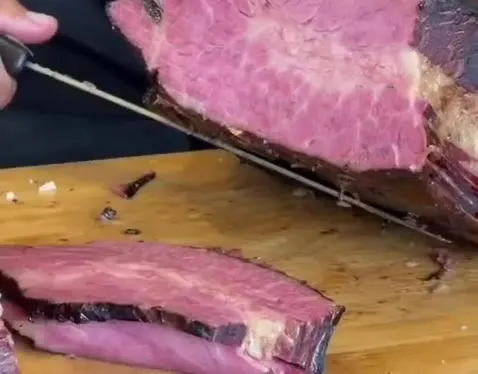
At JOSEPH DELI every cut goes through 18 hours of slow smoking, followed by a steaming stage. The smoke is what builds the dark, peppery bark; the steam is what works through the inside of the cut, leaving it soft and juicy rather than dry.
This is not a shortcut around the classic method — it is the same logic described above, applied to brisket. The long hours are not for show: they are what it takes for connective tissue to genuinely break down.
Sliced only after you order
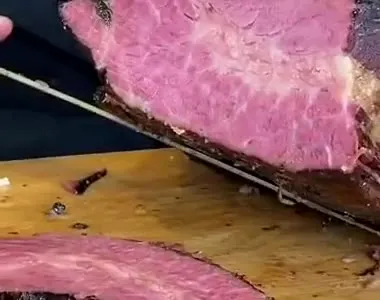
We do not pre-slice. Every sandwich is carved by hand from the whole cut, after you order.
There is a practical reason for that, not just an aesthetic one. Hot meat whose collagen has already turned to gelatin simply falls apart in a slicing machine — a machine needs a cold, firm block. Hand-slicing is the only way to keep a slice intact in that state. Cutting against the grain also shortens the fibres you have to bite through, which changes how it eats.
There is a deliberate trade-off here too: leaner meat is easier to machine-slice and keep as cold cuts. That is precisely what we are not doing.
How is this different from the pastrami Israelis know?
This is probably the biggest gap, and it confuses a lot of people. What is sold in Israel as "pastrama" is usually a low-fat turkey or chicken product, pre-sliced, and served cold as a sandwich filling.
New York-style pastrami is a different thing: fatty beef, cured for weeks, smoked and steamed, carved hot and thick off the whole cut. Same word, different food.
That difference is also why people trying one for the first time are surprised. They expect a thin cold slice and get a hot pile.
What about corned beef, Montreal smoked meat and basturma?
Corned beef: the same curing family, a different ending. Corned beef is cured and boiled in water — no exterior spice, no smoke, no steam. Pastrami is cured, rubbed, smoked and steamed.
Montreal smoked meat: very close, and still not the same. It is made mostly from brisket, usually dry-cured, and its spice mix is sharper — more pepper and garlic, without the sugar that shows up in pastrami.
Turkish or Armenian basturma: despite the shared etymology, it is the opposite product on almost every axis — air-dried, never cooked, coated in a fenugreek and cumin paste, and sliced very thin.
And Katz’s? The historical context, and the disclaimer
You cannot discuss hot pastrami sandwiches without mentioning Katz’s Delicatessen on the Lower East Side — the deli associated more than any other with the big hot sandwich. It dates its founding to 1888 (archival research suggests a later date), and is reported to serve some 15,000 lb of pastrami a week. Slicing there is done by hand, and the cutters are a trade in their own right.
So, explicitly: JOSEPH DELI has no official affiliation with Katz’s Delicatessen. We are an independent Israeli business drawing on the New York deli tradition. We do not sell a Katz’s product, we do not operate under their licence, and we do not represent them. When we mention them it is as historical context — the way you would name a well-known place to explain a style.
One difference is worth noting: Katz’s itself is not kosher. JOSEPH DELI is, under the supervision of the Pardes Hanna-Karkur Rabbinate.
Kosher New York pastrami, in Israel
There is a neat circularity here. American pastrami is beef partly because the immigrants making it kept kosher. The method was built inside a kashrut constraint from the start.
JOSEPH DELI is kosher under the supervision of the Pardes Hanna-Karkur Rabbinate. What we serve is that style — a long smoke, a steam, hand-sliced to order — without compromising on kashrut.
Where can you eat one of these in Israel?
Joseph Deli is a permanent meat food truck in the Shevet Brewery complex in Pardes Hanna-Karkur. Everything is carved on the spot, after you order.
Haroshet 2Shevet Brewery complexPardes Hanna-KarkurOpening hours
- Tuesday18:30-22:30
- Wed-Thu12:30-16:00
- 18:30-22:30
- Friday11:30-15:00
Pastrami FAQ
- What is New York-style pastrami?
- A whole beef cut that is salt-cured, coated in a black pepper and coriander spice mix, smoked for hours and then steamed. It is carved hot and by hand, and served in a sandwich — not as cold slices from a package.
- What is the difference between New York pastrami and regular pastrami?
- The pastrami sold in Israel is usually a low-fat turkey or chicken product, pre-sliced and served cold. New York pastrami is fatty beef, cured for weeks, smoked and steamed, then carved hot and thick off the whole cut.
- Why is the meat steamed after smoking?
- To break down connective tissue. The collagen in the cut needs sustained heat to turn into gelatin, but the meat has already lost moisture during curing — and continuing in dry heat would dry it out. Steaming holds it in the necessary heat range without losing moisture.
- How much meat is in the large sandwich?
- 350 grams of meat.
- Is JOSEPH DELI kosher?
- Yes. JOSEPH DELI is kosher under the supervision of the Pardes Hanna-Karkur Rabbinate.
- Where can you eat a New York-style pastrami sandwich in Israel?
- JOSEPH DELI is a permanent meat food truck at Haroshet 2, in the Shevet Brewery complex in Pardes Hanna-Karkur, with free parking and outdoor seating.
- Is JOSEPH DELI affiliated with Katz’s Delicatessen?
- No. JOSEPH DELI is an independent Israeli business inspired by New York deli culture and has no official affiliation with Katz’s Delicatessen.
Sources
Food history is full of stories repeated as fact. Where the record is partial — the 1887 date, or Katz’s founding year — we have said so explicitly in the text above.
- Robert F. Moss, “How Pastrami Really Arrived in New York City”, Serious Eats
- Serious Eats, “How Katz’s Delicatessen Makes Their Pastrami”
- Serious Eats, “Pastrami vs. Montreal Smoked Meat”
- ThermoWorks, “How to Make Smoked Pastrami” (process and temperatures)
- Science of Cooking, slow cooking and collagen (summarising Harold McGee)
- New-York Historical Society, “I’ll Have What She’s Having: The Jewish Deli”
- Katz’s Delicatessen, “Our Story”
- Wikipedia, “Pastrami”